Written by the La Firma Design Team, the interior designers, fit out specialists and project managers behind our villa projects across the UAE. Updated 7 November 2026.
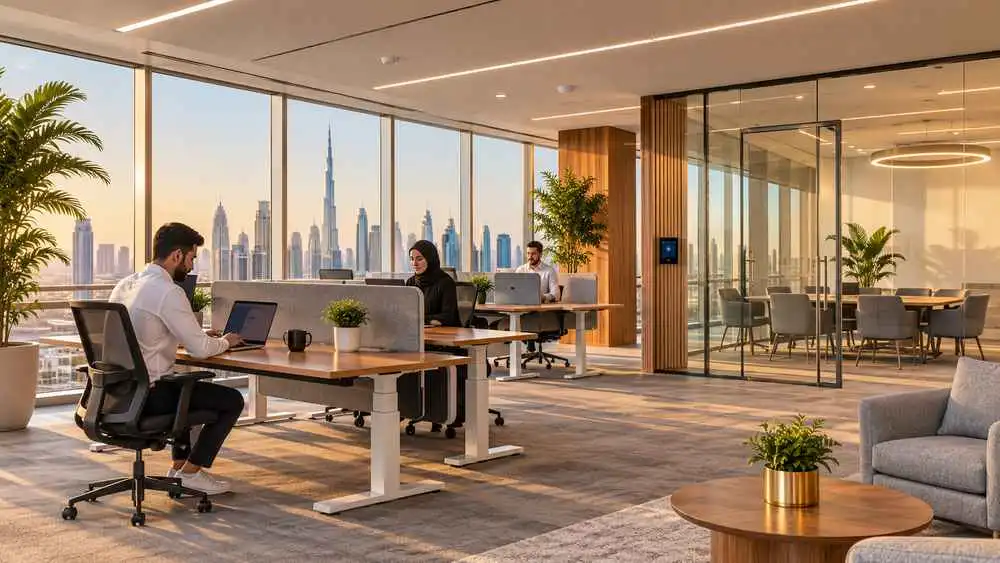
Smart office interior design means planning a workspace’s layout, ceilings, power, cabling and furniture so that technology such as sensor-based lighting, zoned cooling, room booking and access control works smoothly and stays out of sight. In Dubai, you get the best results when the designer, the MEP team and the technology specialist plan together before fit-out begins.
Most smart offices fail quietly. The sensors work, the booking app is installed, and the team still hunts for a free room. The problem is rarely the technology. It is the design around it.
Smart features need ceiling space, power points, network cabling and a layout that makes them useful. Add them late and you pay twice: once for the system and again for the changes that make it fit. Add them early and the office simply feels easier to use.
This guide shows you how to plan a smart office in Dubai the design-first way. You will learn the four layers of a smart workspace, where technology pays off first, what drives the cost and which mistakes to avoid.
What does smart office interior design mean?
Smart office interior design combines interior design with building technology. Designers decide how the space looks, flows and sounds. Technology specialists decide how lighting, cooling, rooms and access respond to the people inside. In a well-run project, both teams work from one plan.
That difference matters. Buying smart devices gives you a gadget list. Designing a smart office gives you a workplace where lights follow daylight, meeting rooms release themselves when nobody turns up, and desks, power and data sit exactly where people need them.
The four layers of a smart office
We plan every smart workspace in four layers. Work from the bottom up, because each layer depends on the one below it.
| Layer | What it covers | Decide it during |
|---|---|---|
| 1. Foundations | Structured cabling, PoE ports, spare conduits, ceiling depth, floor boxes, acoustic treatment | Concept design |
| 2. Comfort | Lighting controls, zoned cooling, shading, air quality sensors | Concept and MEP design |
| 3. Workflow | Room booking panels, desk booking, access control, visitor check-in, AV | Detailed design |
| 4. Insight | Occupancy analytics, energy dashboards | Before handover |
Layer 1, Foundations. This layer is invisible and it decides everything else. Extra conduits, enough ceiling depth for sensors and cabling, and power in the right floor boxes cost little at design stage and a lot once the ceiling is closed.
Layer 2, Comfort. People notice light and temperature before they notice any app. Start here, because comfort gains show up on day one.
Layer 3, Workflow. This layer removes daily friction: finding a room, joining a call, welcoming a visitor.
Layer 4, Insight. Collect data only after the first three layers work. Use it to answer one question, such as which rooms stay empty, then act on the answer.
Where smart technology pays off first
Lighting
Lighting is the easiest place to start and the easiest to measure. In a Lawrence Berkeley National Laboratory test of private offices, occupancy sensors cut lighting energy use by 20 to 26 percent compared with manual switching. A US General Services Administration study of wireless advanced lighting controls reported 39 percent lighting savings against an automated schedule, with occupancy sensing, tuning and daylight harvesting all contributing.
Both studies come from US buildings, so treat the numbers as a guide, not a promise. Your savings depend on your fittings, your working hours and the daylight on your floor. In Dubai, glass-fronted floors make daylight sensors and shading worth a serious look. Pair them with a lighting plan that avoids glare on screens. Our guides to office lighting in Dubai and natural light design in the UAE cover the design side.
Cooling and air quality
Cooling is one of the biggest comfort complaints in Dubai offices, and it ties closely to your building. In many towers, the landlord controls the base-building air conditioning. Your fit-out can add zoning, local thermostats and air quality sensors, but only within the building’s rules. Ask for the tenant fit-out manual early and bring your MEP team in during the first week of design. Our notes on designing for the UAE climate and choosing MEP contractors in Dubai explain what to ask.
Meeting rooms and desks
Hybrid work puts pressure on rooms. A booking panel at the door and a sensor that releases empty bookings solve the most common complaint: rooms that look booked but stay empty. Choose one video-conferencing standard for the whole floor, such as Microsoft Teams Rooms or Zoom Rooms, so every room works the same way. If you want to divide rooms without losing light, consider glass partitions, with switchable glass where privacy matters.
Furniture that supports the tech
Height-adjustable desks, cable-managed tables and power-ready lounge seating make the technology usable. See our office furniture ideas for UAE workspaces for layouts that work.
Design details that keep technology out of sight
- Align sensors, diffusers and light fittings on one reflected ceiling plan so the ceiling looks calm.
- Place booking panels at the same height and on the same side of every door.
- Hide cables in desks, walls and floor boxes, not along skirting boards.
- Treat acoustics as part of the system. Hard glass and open ceilings amplify noise, and no sensor fixes that.
- Keep manual overrides. People trust a space more when they can adjust the light or temperature themselves.
Smart office planning for Dubai conditions
- Summer cooling load: Plan zoning around sun-facing facades and the hours people actually use each area.
- Glass facades: Combine daylight sensors with shading, and test glare at different times of day.
- Landlords and free zones: Each tower and free zone, such as DMCC or DIFC, sets its own fit-out and approval rules. Confirm them before you finalize any ceiling devices.
- Ramadan and prayer spaces: Set lighting and cooling scenes for shorter working hours, and give any prayer or quiet room its own controls.
- Language: Offer panels and apps in Arabic and English.
- Data privacy: Occupancy sensors can count people without identifying them. Choose anonymous counting where you can. Ask your legal advisor how the UAE’s Federal Decree-Law No. 45 of 2021 on personal data protection, or the DIFC Data Protection Law if you operate there, applies to any system that identifies individuals.
What does a smart office cost in Dubai?
No honest price exists without a site visit, because scope changes everything. These factors drive the cost most:
- New fit-out or retrofit. A retrofit usually needs more labor and more work around your staff.
- Floor size and meeting room count.
- Number of connected systems. Lighting only costs less than lighting, cooling, access and AV together.
- Your building’s control system and what it allows tenants to change.
- Software licenses and support, which often renew every year.
Ask every bidder for an itemized quote that separates one-time hardware and installation from yearly software and support fees. If your budget is tight, start with lighting controls and meeting rooms, then add layers later. Still include Layer 1 now. It is cheap to build in and costly to add afterwards. For the wider budget, read our breakdown of office interior design costs in Dubai.
How we plan a smart office project
- Brief and workplace audit. We ask how many people attend on a typical day and which rooms are full or empty.
- Concept and zoning. We draw the layout and ceiling plan together, so technology has a home before anyone buys it.
- Technical coordination. We align the design with your MEP team, your landlord and your technology specialist.
- Approvals. We prepare drawings for the building and the relevant authorities.
- Fit-out and commissioning. We test every lighting scene, sensor and booking flow before handover, with project management keeping the schedule tight.
- Handover, training and 30-day tuning. Sensors need adjusting once real people use the space.
If you prefer one team for design and construction, read how design and build in the UAE works. To prepare your own list, use our office renovation checklist.
Smart office readiness check
Answer these seven questions before you speak to any designer or vendor:
- Do you know which rooms are overused and which stay empty?
- Does your lease or building manual limit changes to the ceiling or air conditioning?
- Can your network and power support extra devices?
- Who will own and maintain the system after handover?
- Which one problem do you want to solve first?
- Will you tell employees what data the sensors collect?
- Is there a budget for yearly support?
If you can answer fewer than four, start with a workplace audit, not a product list.
Common mistakes to avoid
- Buying technology before the layout is final.
- Running several apps that do not talk to each other.
- Ignoring the landlord’s rules until late in the project.
- Skipping staff training.
Our post on common office design mistakes covers the non-tech errors too.
How La Firma Interiors approaches smart offices
La Firma Interiors has designed and fitted out spaces across the UAE since 2018. On smart office projects, our designers lead the plan and coordinate the MEP team, technology specialists and approvals, so one team answers for the result. Our fit-out service covers the build from drawings to handover.
Frequently asked questions
Q1: What is smart office interior design?
A: It is the planning of an office’s layout, ceilings, power, cabling and furniture so that smart technology such as sensor lighting, zoned cooling and room booking works well and stays hidden. Design and technology share one plan.
Q2: How much does it cost to make an office smart in Dubai?
A: The cost depends on size, whether you are building new or retrofitting, how many systems you connect and what your building allows. Request an itemized quote that separates one-time costs from yearly software and support fees.
Q3: Can I add smart features to an existing office?
A: Yes. Lighting controls, room booking and access control suit retrofits well. Work that needs new ceilings, cabling or air conditioning changes costs more and may need landlord approval.
Q4: Do smart offices really save energy?
A: Lighting controls have strong evidence behind them. US studies report lighting savings of 20 to 39 percent depending on the system. Cooling savings depend on how much control your building gives you.
Q5: Is a smart office worth it for a small team?
A: Often yes, if you start small. Sensor lighting and a simple room booking system deliver the quickest gains without a large budget.
Q6: How long does a smart office project take?
A: Timelines depend on size and approvals. The smart layer adds design coordination at the start and a commissioning period at the end, so plan for both.
Q7: Do occupancy sensors affect employee privacy?
A: They can, if they identify individuals. Anonymous people-counting reduces the risk. Take advice on UAE data protection rules and tell your team what you collect.
Plan your smart office with La Firma
Ready to plan a smart office that your team enjoys using? Book a free consultation with our office interior design team in Dubai. Call or WhatsApp +971 50 393 0668, or email info@lafirma.ae, and the team at La Firma will review your space and suggest where to start.