Written by the La Firma Design Team, the interior designers, fit out specialists and project managers behind our villa projects across the UAE. Updated 9 November 2026.
Good office lighting in Dubai follows three steps: tame the sun with shading and glazing, layer ambient, task and accent light, then control it with sensors and dimming. As a benchmark, the European standard EN 12464-1 recommends 500 lux and a glare rating (UGR) of 19 or less at computer desks.
Key takeaways
- Dubai offices usually have a glare problem before they have a darkness problem. Fix the sun first.
- Light each zone for its task. Desks, meeting rooms, reception and corridors need different levels.
- Check glare, color rendering and flicker, not only watts and price.
- Sensors and dimming cut waste. US tests report lighting energy savings of 20 to 39 percent, depending on the system.
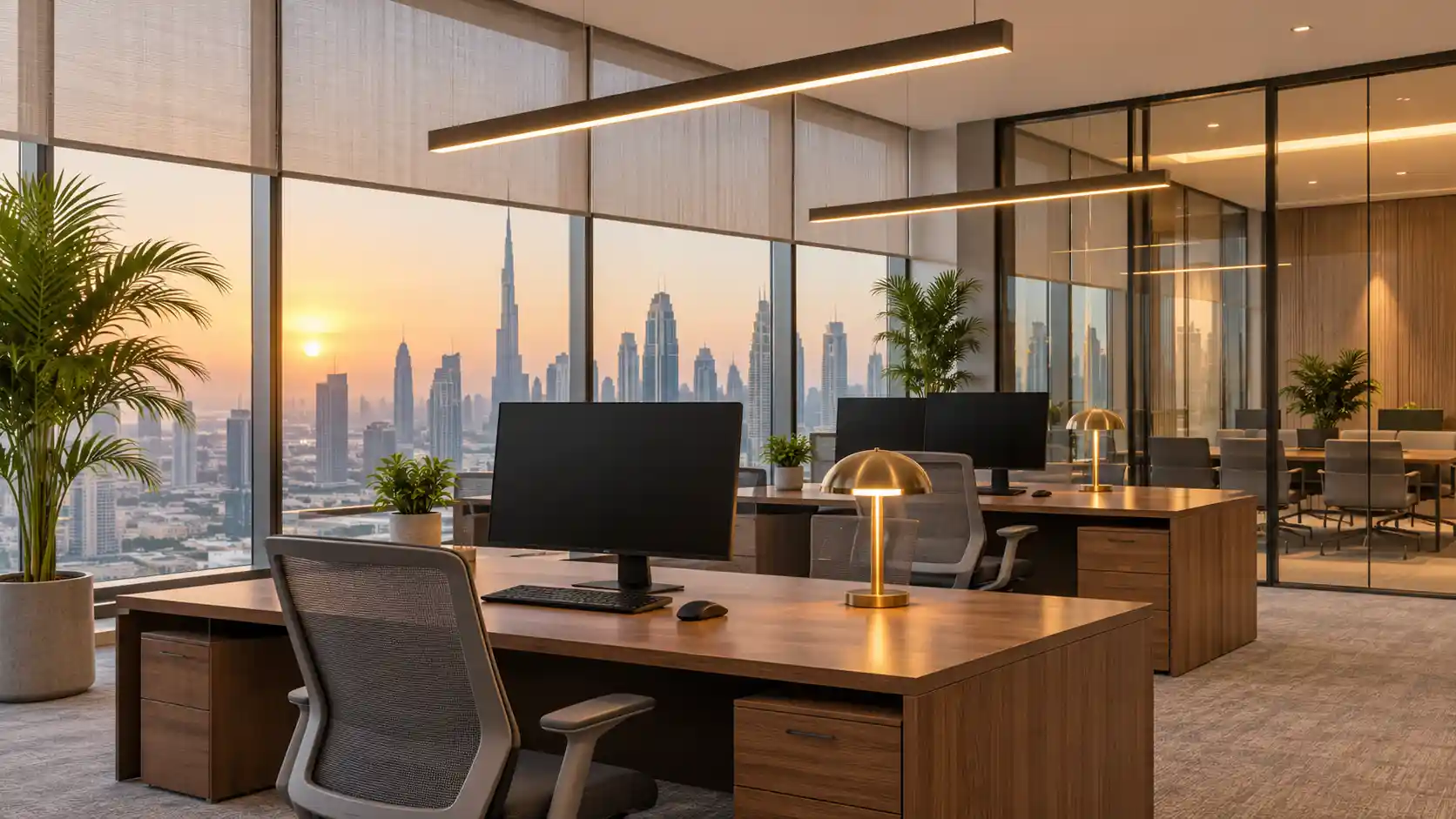
Dubai offices have an odd lighting problem. There is too much light outside and the wrong light inside. Afternoon sun bounces off screens while the corridor behind the desks stays dim. Staff lower the blinds, switch on every ceiling panel and still squint.
Good lighting design fixes this in a set order. This guide shows you how to plan it, with target light levels, color temperatures and glare limits for every zone of a UAE office.
What does good office lighting mean?
Good office lighting gives people enough light for their task, without glare, flicker or harsh contrast, and it uses no more energy than needed. It balances the amount of light (lux), the quality of light (glare, color rendering and color temperature) and control (when and where light turns on).
We plan every office lighting scheme in three steps.
| Step | Question it answers | Main tools |
|---|---|---|
| 1. Tame the sun | How do we control glare and heat from outside? | Shading, glazing, desk orientation |
| 2. Layer the light | What light does each task need? | Ambient, task and accent fixtures |
| 3. Control the scene | How do we avoid waste and adapt through the day? | Sensors, dimming, scenes |
Step 1: Tame the sun
Control daylight before you add fixtures. Low morning and late afternoon sun hits east and west facades hardest, and unmanaged glare is the main reason staff close blinds and run lights all day.
Use shading, solar control film or glazing suited to each facade. Turn screens at right angles to windows so that neither the window nor its reflection sits in the line of sight. Keep tall furniture and solid walls away from the glass, and consider glass partitions so daylight reaches the interior. Our guide to natural light design in the UAE covers shading and layouts in more detail.
Daylight also saves energy. A British University in Dubai study modeled lightshelves with dimming in Dubai office modules and reported lower energy use while light reached deeper into the room. Because lighting adds heat that your air conditioning must remove, efficient fixtures and good shading also ease the cooling load. Our notes on designing for the UAE climate explain why.
Step 2: Layer the light
Use three layers. Ambient light fills the room, task light serves the work surface and accent light highlights walls, brand features or art. One layer alone leaves a space flat or harsh.
- Ambient: recessed panels, linear lights or suspended fixtures with an indirect component.
- Task: desk lamps and under-shelf lights where people read or do detailed work.
- Accent: track spots and wall washers on a brand wall, a feature or a plant.
| Fixture | Best for | Watch out for |
|---|---|---|
| Recessed panels | Open plan, corridors | Glare from poor diffusers, so check the UGR rating |
| Linear lights | Open plan, meeting rooms | Alignment with the ceiling grid, sprinklers and detectors |
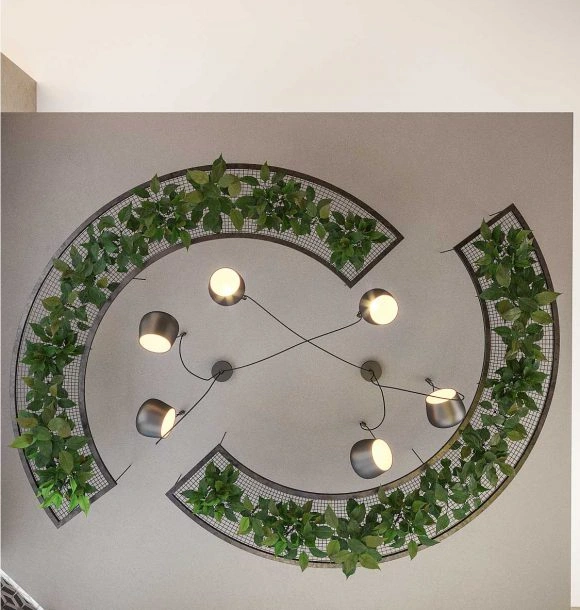
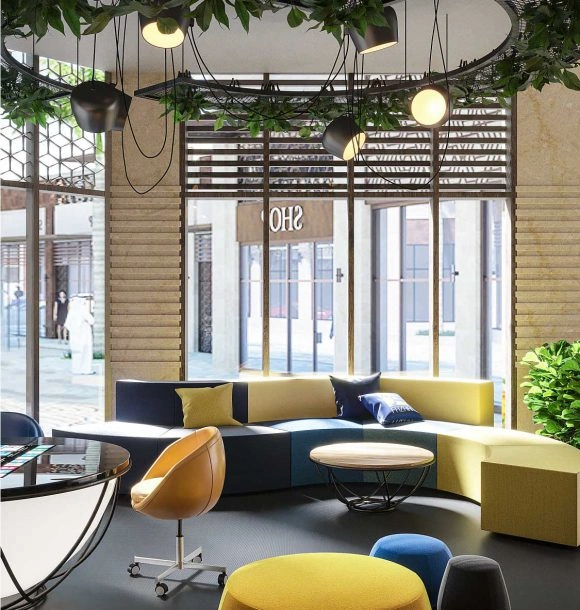
| Suspended lights | High ceilings, desk clusters | Dust on top surfaces and cleaning access |
| Track and spot lights | Reception, brand walls | Aiming, so spots stay out of screen reflections |
| Desk lamps | Reading and detail work | Power points and cable routes |
What light level, glare limit and color does each zone need?
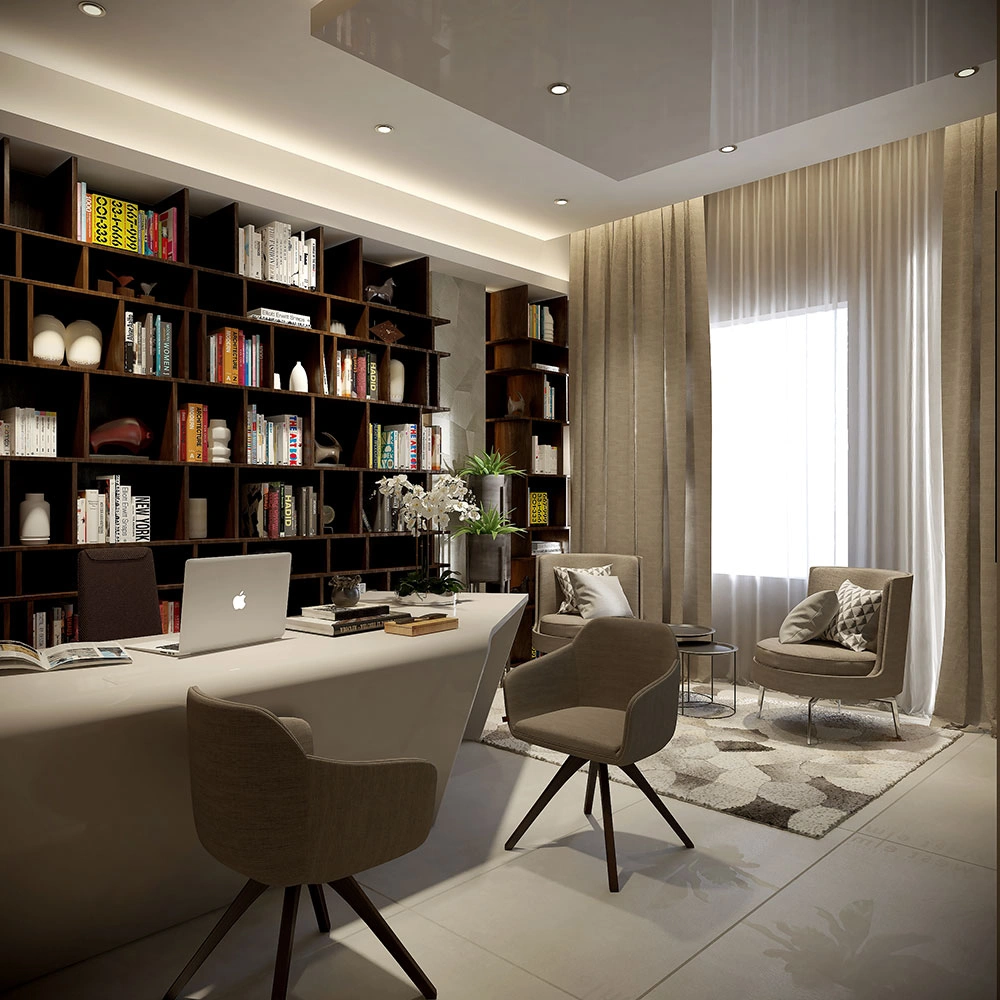
Desks and meeting rooms need about 500 lux, reception desks and copying areas 300 lux, and corridors 100 lux, based on EN 12464-1. Work areas also need a glare rating (UGR) of 19 or less and a color rendering index (CRI) of 80 or more.
The table uses EN 12464-1 for light levels and glare limits. It is a European standard that many UAE designers use as a benchmark. Your building rules or client brief may set other values, so confirm them before you finalize. Color temperature ranges reflect common design practice, not a legal requirement.
| Zone | Light level | Glare limit (UGR) | Color temperature | Design note |
|---|---|---|---|---|
| Open-plan desks and computer work | 500 lux | 19 or lower | 3500 to 4000K | Add task lights where people read paper |
| Meeting rooms | 500 lux | 19 or lower | 3500 to 4000K | Dimmable, with light on faces for video calls |
| Private and executive offices | 500 lux | 19 or lower | 3000 to 4000K | Layer with dimmable accents |
| Reception desk | 300 lux | 22 or lower | 3000 to 3500K | Add accent light on the brand wall |
| Filing and copying | 300 lux | 19 or lower | 3500 to 4000K | Keep it simple and low glare |
| Washrooms | 200 lux | 25 or lower | 3000 to 4000K | Even light, no dark corners |
| Corridors | 100 lux | 28 or lower | 3000 to 4000K | Avoid dark tunnels beside bright rooms |
| Breakout and pantry | About 200 to 300 lux (typical practice) | Design choice | 2700 to 3000K | Warmer light signals off-duty time |
For leadership spaces, see our executive suite interior design guide. Use CRI 90 or higher where color accuracy matters, such as design studios.
Step 3: Control the scene
Occupancy sensors, daylight dimming and preset scenes cut lighting energy and improve comfort. Lawrence Berkeley National Laboratory found that occupancy sensors cut lighting energy by 20 to 26 percent compared with manual switching, and a US General Services Administration study reported 39 percent savings from wireless advanced controls against an automated schedule.
Both studies come from US buildings, so treat the numbers as a guide, not a promise. Your savings depend on your fixtures, working hours and daylight.
A practical setup looks like this: sensors in meeting rooms and corridors, daylight dimming along windows, scenes for presentations and video calls, and a manual override in every room. Ask for DALI-compatible fixtures if you may add smart controls later, because DALI is a widely used digital lighting control standard. Controls need power, wiring and ceiling space, so bring in your MEP contractors early. Our smart office design guide shows how lighting fits with room booking and cooling.
What to check when choosing LED fixtures
- Glare rating (UGR): ask for tested values for office use.
- Color rendering (CRI): 80 or higher for work areas, 90 or higher for color-critical work.
- Flicker: choose low-flicker drivers, especially when you plan to dim.
- Dimming compatibility: confirm that fixtures and controllers work together.
- Lifespan and warranty: get the warranty terms in writing.
- Color consistency: check that fixtures from different batches match.
LED usually uses far less energy than halogen and older fluorescent lamps. The saving shrinks against efficient modern fluorescents, so ask for a like-for-like comparison.
What does office lighting cost in Dubai?
No fair price exists without a plan and a site visit. These factors drive the cost most:
- New fit-out or retrofit. Keeping the ceiling grid and swapping fixtures usually costs less than redesigning the ceiling.
- Ceiling type and access.
- Number of zones and scenes.
- Fixture quality and glare rating.
- Controls and wiring.
- Cleaning and maintenance access.
Ask every bidder for an itemized quote that separates fixtures, controls, installation and commissioning. On a tight budget, fix glare first, add task lights and upgrade the areas people use most. Our guides to office interior design costs in Dubai and budget-friendly office design help you set the wider budget.
How we plan office lighting
- Daylight and site check. We note orientation, glazing and shading.
- Zone brief. We list tasks, working hours and screen use for each area.
- Layout and ceiling coordination. We align fixtures with air conditioning, sprinklers, detectors and partitions.
- Visualize and test. You see the scheme in 3D visuals, and we test a sample where it matters.
- Install and commission. We aim fixtures, program scenes and check glare at different times of day.
- Tune after 30 days. Real use reveals what needs adjusting.
For retrofits, use our office renovation checklist to plan the work.
Quick diagnosis: what your symptoms say about your lighting
| What you notice | Likely cause | Fix |
|---|---|---|
| Tired eyes or headaches by afternoon | Glare or flicker | Check UGR, shading and driver quality |
| Window reflections on screens | Desk orientation | Turn screens at right angles to windows |
| Faces look dark on video calls | Light only from above | Add front or vertical light and a dimmable scene |
| Bright desks but dark corridors | Poor balance | Raise corridor and wall light levels |
| Blinds closed and lights on all day | Unmanaged glare | Add shading and daylight dimming |
| Lights on in empty rooms | No sensors | Add occupancy sensing in meeting rooms and corridors |
Lighting is one of ten errors in our guide to common office design mistakes.
How La Firma Interiors plans office lighting
La Firma Interiors is a Dubai-based interior design and fit-out company that has worked across the UAE since 2018. We draw the lighting plan in the same drawing set as the ceiling, cooling and furniture, so the layers never clash. Our fit-out service then carries the project from drawings to handover.
Frequently asked questions
Q1: How many lux does an office need?
A: EN 12464-1 recommends 500 lux for computer work and meeting rooms, 300 lux for reception desks and copying, and 100 lux for corridors. Your building rules or client brief may set other values, so confirm them before you finalize.
Q2: What is the best color temperature for an office?
A: Most offices use 3500 to 4000K for work areas, which looks neutral and alert. Use 3000K or warmer in lounges and reception. Choose by task and mood, and keep the temperature consistent within each zone.
Q3: What is UGR?
A: UGR stands for Unified Glare Rating. It measures discomfort glare from fixtures, and lower values mean less glare. EN 12464-1 sets a limit of 19 for office and computer work.
Q4: Is LED lighting good for offices?
A: Yes. LED offers high efficiency, long life and easy dimming. Quality varies, so check glare, color rendering, flicker and warranty rather than choosing on price alone.
Q5: How do I reduce glare from the Dubai sun on screens?
A: Use shading or solar control film, turn screens at right angles to windows, keep bright fixtures out of screen reflections and add daylight dimming. Fix glare before you add more fixtures.
Q6: How much does office lighting cost in Dubai?
A: The cost depends on whether you are building new or retrofitting, the ceiling type, the number of zones, fixture quality and controls. Request an itemized quote that separates fixtures, controls, installation and commissioning.
Q7: Can I upgrade my office lighting without a full renovation?
A: Often, yes. You can swap fixtures, add controls and add task lights without changing walls. New wiring, ceiling changes or cooling alterations need more planning and may need landlord approval.
Q8: Does lighting affect productivity?
A: Light affects comfort, eye strain and alertness, which all support focus. No single percentage applies to every office, so treat good lighting as a comfort and efficiency measure, not a guaranteed output boost.
Get a free office lighting review
Need a lighting plan that fits your floor? Book a free consultation with our office interior design team in Dubai. Call or WhatsApp +971 50 393 0668, or email info@lafirma.ae, and the team at La Firma will review your space and suggest where to start.