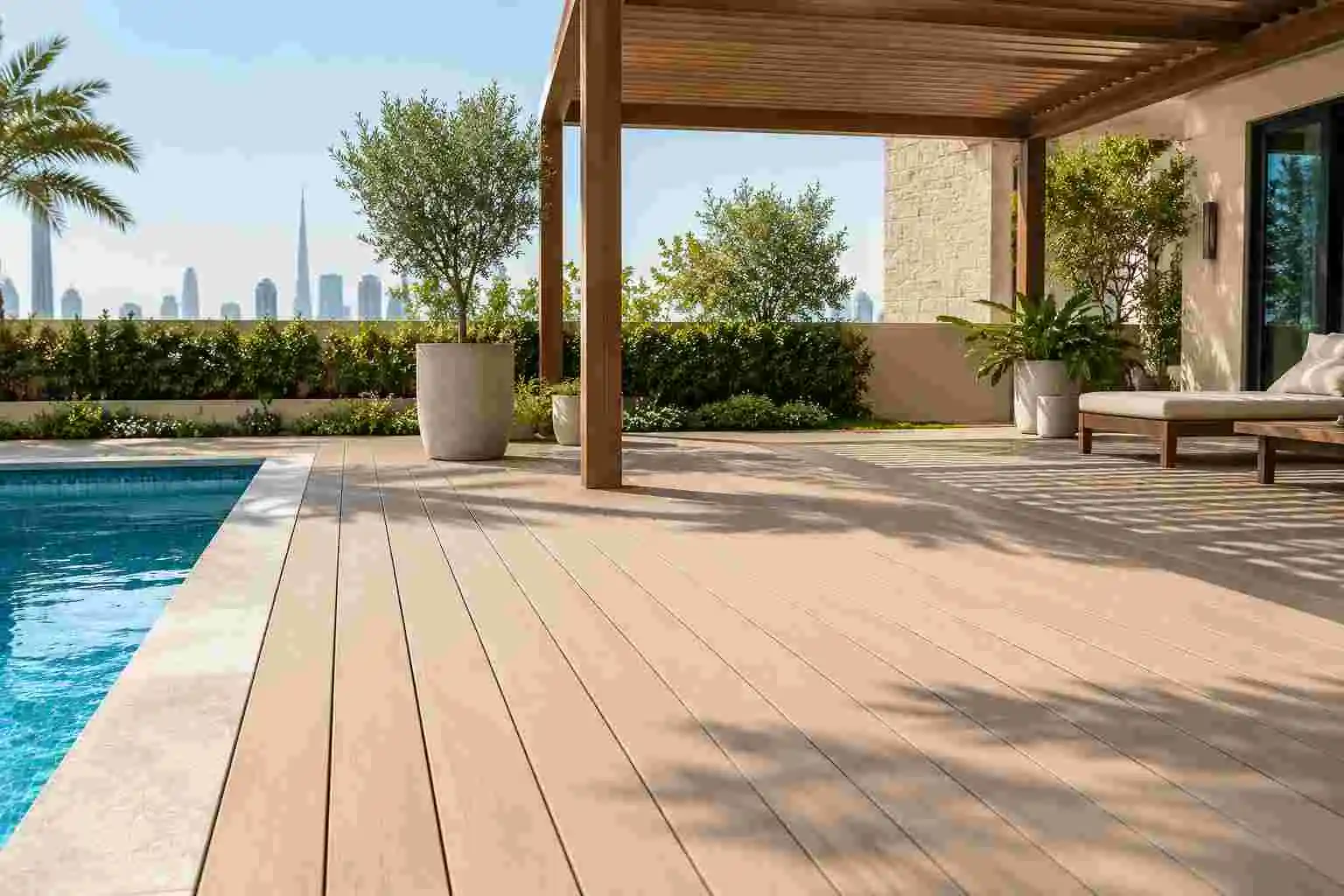
WPC decking in Dubai resists moisture, termites and warping far better than natural timber. It still absorbs heat in direct sun, but it handles the climate more consistently than wood or stone over time. For most villas, a solid-core board in a lighter tone suits a pool deck, while hollow-core boards work well on shaded balconies. This guide covers the honest heat answer, board types, real cost ranges, and how to choose the right grade.
WPC decking in Dubai is a wood-plastic composite board. Suppliers build it for pool decks, balconies, patios and gardens across UAE villas. It handles Dubai’s climate better than timber over the long run, even though it still gets warm underfoot in direct sun.
If you’ve searched this topic already, you’ve probably noticed something odd. Some pages claim WPC decking “stays cool” in the Dubai sun. Others admit it gets hot to walk on barefoot. Both statements hold some truth, and this guide explains why. It also covers board types, real costs and the mistakes worth avoiding before you commit. If the decking is part of a bigger outdoor project, check our villa interior design service and our villa landscaping guide for how it fits the wider plan.
What Is WPC Decking?
WPC stands for wood-plastic composite, a blend of wood fibre and recycled plastic engineered to look like timber but perform better outdoors.
Manufacturers blend wood fibre, typically 45 to 60%, with recycled plastic, UV stabilisers and other additives. They extrude the mix into deck boards that look and feel like timber but behave more like an engineered material. WPC doesn’t rot, splinter or attract termites. It also holds its shape far better than wood through Dubai’s heat and humidity swings.
Types of WPC Decking Boards
Hollow-core boards suit light-traffic, shaded areas. Solid-core and co-extruded boards suit pool decks and high-sun spaces.
Not every WPC board performs the same way. The construction type matters more than most suppliers explain.
| Board Type | Best For | Strength | Watch Out For |
|---|---|---|---|
| Hollow-core | Balconies, shaded patios, lighter-traffic areas | Lighter, more affordable, easier to install | Less dense, can flex more under heavy furniture or foot traffic |
| Solid-core | Pool decks, open terraces, high-traffic commercial areas | Denser, more stable under heat cycling, handles weight well | Heavier, costs more, needs a sturdier subframe |
| Co-extruded (capped) | Any outdoor space, especially high-sun exposure | A protective plastic shell resists fading and moisture better | Costs more than uncapped boards; check the cap thickness |
For a typical villa, solid-core or co-extruded boards suit the pool deck and main terrace. Hollow-core boards work fine on a shaded balcony or secondary patio.
Does WPC Decking Actually Stay Cool in Dubai?
No. It absorbs heat like any solid material, but it releases that heat more gradually than tile or stone, which makes it more comfortable in practice.
No decking material stays cool in direct Dubai sun. Any page claiming WPC “won’t get hot” is overselling it. WPC does, however, behave differently from tile or stone. It releases heat more gradually, so while the surface can get warm underfoot at midday, it doesn’t carry the same sharp, burning heat that ceramic tiles or natural stone often do.
Two things genuinely affect comfort. Colour matters a lot: darker boards absorb more heat and run noticeably hotter than lighter, warm-grey or sand-toned boards. Shade matters even more. A pergola, umbrella or overhang over your deck makes a bigger difference to comfort than the board choice itself. Plan the shading alongside the decking if you want a deck that’s usable barefoot at 2pm in July, not as an afterthought.
Choosing the Right WPC Decking for Your Space
Match the board to how the space gets used: solid-core for pool decks and open terraces, hollow-core for shaded, lower-traffic areas.
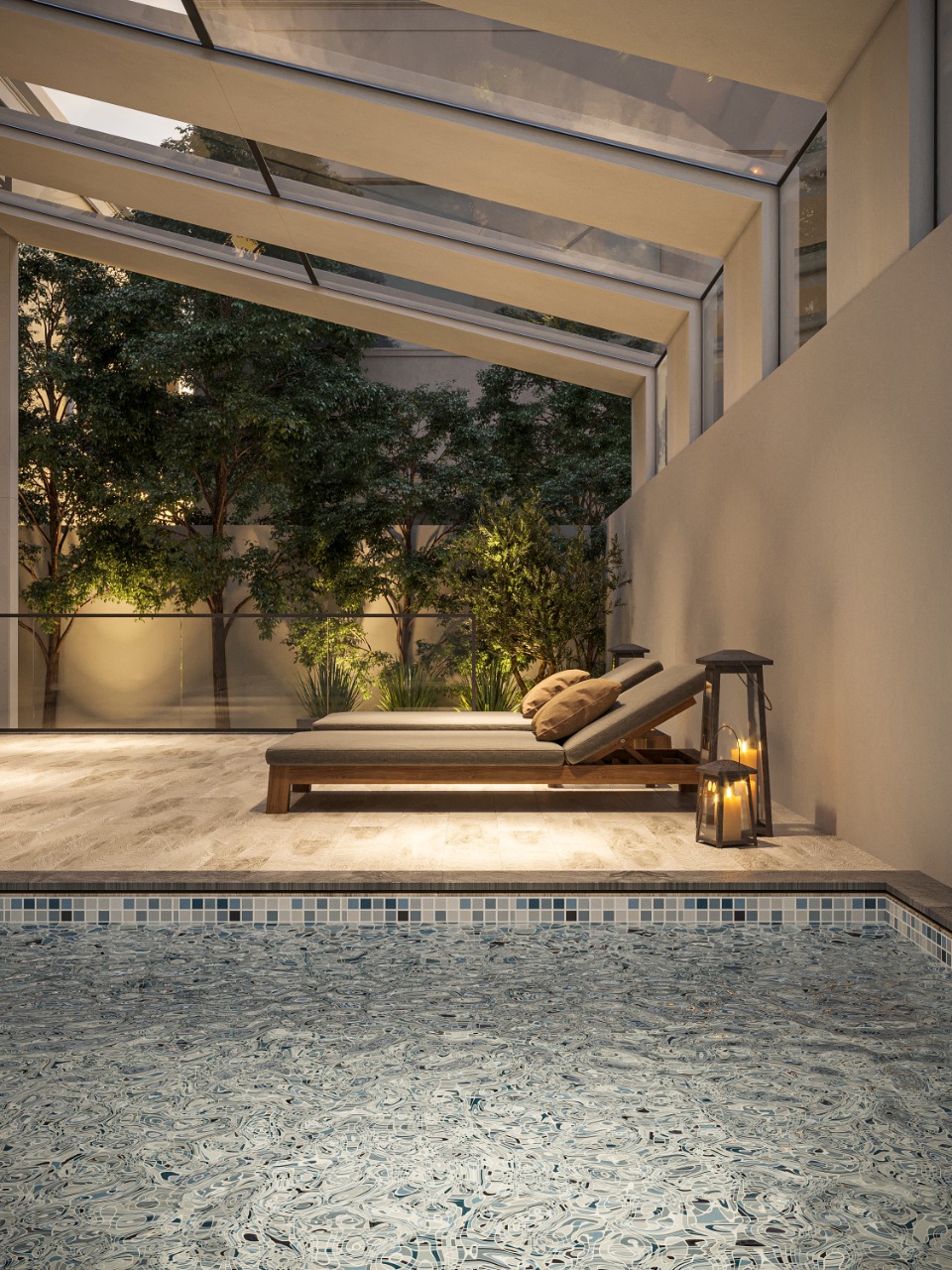
A pool deck takes constant sun, splash and foot traffic, so a solid-core or co-extruded board in a lighter tone makes sense here. A covered balcony sees far less direct sun, so a hollow-core board saves cost without sacrificing performance. A garden walkway sits somewhere in between, and the right choice depends on how much shade the path gets through the day.
Think about your pool area’s design as a whole before locking in the decking. The deck edge, coping and surrounding planting all affect how the board performs and looks over time.
How Much Does WPC Decking Cost in Dubai?
Prices range from roughly AED 95 to over AED 600 per sqm, driven mainly by board density, core type and UV rating rather than inconsistent pricing.
Published prices for WPC decking in Dubai vary enormously. A thin hollow-core board without UV capping sits at the low end. A dense, co-extruded, UV-stabilised solid board sits at the high end. Installation complexity, subframe requirements and site access also shift the final number significantly.
Treat any single figure you see online as a starting reference, not a quote. Ask your supplier or contractor for the board’s density, core type and UV rating. Those three details explain most of the price difference you’ll see between quotes.
WPC Decking vs Other Outdoor Flooring
WPC beats timber on upkeep, beats tiles on comfort underfoot, and suits raised decks better than pavers suit ground-level paving.
Natural timber has a warmer, more natural feel, but it needs far more upkeep and struggles with Dubai’s heat and humidity over time. WPC resists warping and cracking in the same conditions, though it costs more upfront than basic timber. Outdoor tiles can look more premium in a formal setting, yet they get genuinely hot to walk on in direct sun. WPC stays more comfortable underfoot by comparison. Interlock pavers suit ground-level driveways, pathways and larger hardscape areas better, while WPC gives a softer, warmer surface suited to a raised deck application. For indoor-to-outdoor continuity, some villas pair outdoor WPC with SPC flooring indoors, since both resist moisture well on either side of a sliding door.
Maintaining WPC Decking in Dubai
Sweep regularly, wash occasionally with mild detergent, and check the subframe once a year.
WPC decking needs far less maintenance than timber, but it isn’t maintenance-free. Sweep it regularly to clear sand and dust, which builds up fast in an open Dubai garden. Wash it occasionally with water and a mild detergent. Clean up oil, sunscreen or food stains quickly before they set into the surface. Check the fixings and subframe once a year, since this is usually where problems show up first, not in the board itself.
Common Mistakes to Avoid With WPC Decking
Picking a board on price alone, ignoring colour and heat, and skipping subframe ventilation cause most long-term problems.
Choosing a board purely by price, without checking the core type, is the most common mistake. It usually means a hollow-core board ends up on a high-traffic pool deck where it wasn’t designed to perform. Picking a dark colour for an unshaded area causes the second common problem, and owners are often surprised when it runs hot. Skipping proper subframe ventilation creates the third issue, and it affects drainage in a way that can shorten the board’s lifespan during Dubai’s heavy summer humidity. Planning the board grade, colour and shading together avoids all three.
Where WPC Decking Fits Into Your Outdoor Project
A deck rarely stands alone. It connects your pool, garden and villa exterior into one usable outdoor space, so it’s worth planning alongside those elements rather than choosing it in isolation. Our guide to modern villa exterior design in Dubai covers how materials, shading and layout work together if your deck is part of a wider exterior refresh. For a fuller renovation, our home renovation service can bring the decking, landscaping and interior together as one project.
Reach out to La Firma if you’d like help choosing the right WPC decking for your villa.
Frequently Asked Questions
Q1: Does WPC decking get hot in the Dubai sun?
A: Yes, it absorbs heat like any solid outdoor material, but it releases that heat more gradually than tile or stone. Lighter-coloured boards and proper shading make the biggest difference to comfort underfoot.
Q2: How much does WPC decking cost in Dubai?
A: Prices range widely, roughly AED 95 to over AED 600 per sqm, depending on board density, core type and UV rating. Ask your supplier for these three specs rather than comparing price alone.
Q3: Is WPC decking better than natural wood for Dubai villas?
A: For most outdoor applications, yes. WPC resists moisture, termites and warping far better than timber in Dubai’s climate, and it needs much less upkeep. Some owners still prefer real wood’s natural feel despite the extra maintenance.
Q4: Can I install WPC decking myself?
A: Small sections are sometimes DIY-friendly, but a proper subframe, drainage and fixing setup matters for long-term performance. Professional installation protects the investment for a pool deck or any larger area. You can talk through your options with the La Firma team.
Getting WPC Decking Right for Your Dubai Villa
WPC decking earns its popularity in Dubai for good reason. It resists moisture, termites and warping better than timber, and it needs far less upkeep over the years. It still gets warm in direct sun, and no honest guide should tell you otherwise.
Match the board type to your space: solid-core or co-extruded for a pool deck and open terrace, hollow-core for a shaded balcony. Choose a lighter tone if comfort underfoot matters. Plan shading alongside the deck rather than after it. Get these decisions right, and WPC decking becomes a genuinely low-maintenance surface that holds up to Dubai’s climate for decades.
Reach out to La Firma if you’d like a second opinion on the right board and layout for your outdoor space. We can walk through material, shading and placement with you before you start.