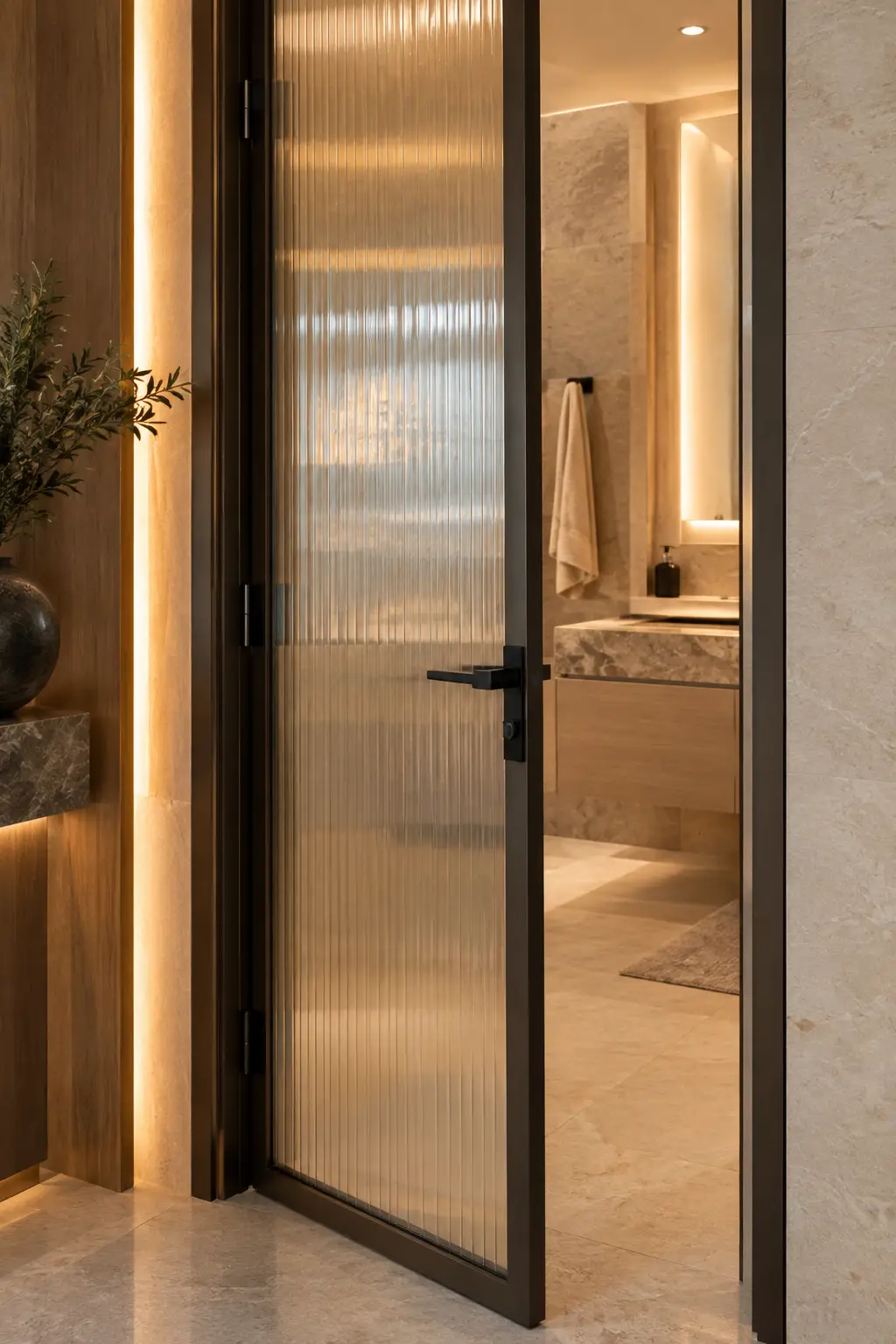
Choosing bathroom doors in Dubai comes down to three decisions: a material that won’t swell, warp or corrode in daily steam and year-round humidity, a door type that actually fits your space, and a privacy solution that still lets the room breathe. Get bathroom doors in Dubai wrong and you’re often replacing a swollen panel or a rusted hinge within two or three years. Get them right, and the door becomes one less thing you ever have to think about.
If your current door is sticking at the base, showing rust around the hinges, or bowing slightly at the bottom edge, that’s almost always moisture damage rather than a fault with the door itself. This guide walks through the materials, door types and privacy choices that hold up best in a UAE bathroom, plus a few details most suppliers never mention. If the door is part of a wider bathroom refresh, our home interior design service can plan it alongside the rest of the room, and our guide to planning a bathroom renovation in Dubai covers the sequence.
The Best Bathroom Doors for Dubai Homes
For most Dubai bathrooms, PVC or aluminium doors handle daily humidity and steam best, WPC is a strong middle ground if you want a warmer look, and sliding or pocket doors solve most small-bathroom layout problems. Pair any of these with frosted or louvered glass for privacy that doesn’t trap moisture in the room. Solid wood and steel only suit specific situations, covered below.
Why Bathroom Doors in Dubai Need Different Materials Than Other Rooms
Every door in your home takes wear, but a bathroom door in Dubai deals with something extra. It absorbs repeated cycles of steam and condensation, often sits right next to a shower or wet room, and does all of this on top of outdoor humidity that stays high for months at a stretch. A standard interior door built for a hallway or bedroom starts failing faster than you’d expect once it’s doing bathroom duty.
The failure points are predictable, and once you’ve spotted a few, you start noticing them everywhere: timber swelling at the bottom edge where moisture collects, laminate finishes bubbling near the frame, and metal hardware rusting within a year or two of installation. None of this means your door has to be purely functional and forgettable. It means the material and the hardware need choosing for the room, not just for the photo.
Which Material Is Best for Bathroom Doors in Dubai? (Comparison Table)
Every supplier in Dubai will tell you their material resists moisture. That’s mostly true, but resistant isn’t the same as maintenance-free, and each option carries a real trade-off worth knowing before you commit.
| Material | Look | Strength in a Humid Bathroom | Watch Out For |
|---|---|---|---|
| PVC | Simple, clean, often mimics wood grain | Lightweight, fully water-resistant, budget-friendly | Can look less premium up close, needs quality hinges |
| Aluminium | Slim frames, modern, pairs well with glass | Corrosion-resistant, stable in heat and moisture, low maintenance | Feels cool to the touch, thin profiles can flex without a reinforced frame |
| WPC (wood-plastic composite) | Warmer than PVC, wood-like texture | Resists swelling, warping and termites better than solid wood | Quality varies a lot between suppliers, ask for the composite ratio |
| Solid wood with a protective finish | Warmest, most premium feel | Fine if properly sealed and kept away from direct splash | Needs the finish reapplied every couple of years, weakest choice for direct wet-area use |
| Tempered glass (frosted or patterned) | Contemporary, lets in borrowed light | Doesn’t absorb moisture at all | Needs a well-sealed frame, not full privacy on its own |
| Steel | Heavy-duty, industrial | Very durable and fire-resistant | Rarely worth it for a home bathroom, better for commercial washrooms |
For most homes, PVC or aluminium is the safe default for a door that takes direct splash. WPC works well if you want something warmer without wood’s upkeep, and solid wood or glass suit doors that stay clear of direct water.
What Type of Bathroom Door Suits Your Space?
Sliding or pocket doors solve most small-bathroom problems, hinged doors are simplest when you have room to spare, and bi-fold or frameless glass suit narrow or open-plan layouts. Here’s how to decide.
Hinged Doors and Swing Clearance
A standard hinged door is still the simplest option, but it needs a clear swing arc, roughly the door’s width plus enough space for someone to stand comfortably on the other side. In a compact ensuite or guest bathroom, that swing eats into space you don’t have. Measure the arc against your actual layout before committing, not just the door width. Our master bathroom layout ideas cover clearance planning in more depth.
Sliding and Pocket Doors for Small Bathrooms
Sliding doors run along a track in front of the wall, and pocket doors slide fully inside a cavity within it. Both remove the swing problem entirely, which makes them the strongest option for small bathrooms and apartments. The catch is timing: a pocket door needs planning before the wall is finished, since it requires a cavity, so it’s a poor retrofit once tiling and plumbing are in. A surface-mounted sliding door is easier to add later, but it needs a clear stretch of wall to slide across.
Bi-Fold and Frameless Glass Doors
Bi-fold doors fold in on themselves and suit narrow openings where a full slide or swing won’t fit. Frameless tempered glass doors work well for an open-plan ensuite connected to a bedroom, where the two spaces should feel continuous, but they give almost no acoustic or visual privacy unless paired with frosted or patterned glass.
How Do You Get Privacy Without Blocking Ventilation?
In short, pair a solid or semi-solid door with a frosted, reeded or louvered panel, and leave a small gap under the door so your extractor fan can still pull air out of the room.
Privacy and ventilation are often treated as separate problems, and they shouldn’t be. A fully sealed, solid door looks private but can trap moisture in the room when there’s no other path for air to escape, which is exactly what encourages mould around the frame and skirting. Frosted, reeded or patterned glass panels let in borrowed light while blocking a clear view, and they work well set into an otherwise solid PVC or aluminium door. Louvered doors, with angled slats built into the panel, go a step further and support airflow along with privacy, which suits a bathroom sharing a wall with a hallway or bedroom. This kind of layered thinking matters most in a guest bathroom, where privacy usually matters more than in a family bathroom.
Why Do Bathroom Door Hinges Fail First in Dubai Homes?
Because hinges and tracks are usually standard-grade hardware bolted onto a moisture-resistant door, not moisture-resistant themselves. The door survives; the metal holding it up doesn’t.
Almost every supplier talks about the door panel and says nothing about what’s holding it up. In a humid bathroom, standard hinges, tracks and handles are often the first thing to fail, not the door. Look for stainless steel or coated hardware rated for wet areas, and for sliding doors, check that the track sits somewhere it won’t collect standing water or soap residue. If you’re having a door custom-built, our custom joinery service can specify hardware to match both the material and the room.
A Quick Checklist Before You Choose Bathroom Doors in Dubai
- Confirm whether the door will take direct splash, partial splash, or none at all
- Measure the swing arc against your actual layout, not just the door width
- Ask what the hinges, handles and tracks are made from, not just the door panel
- Check whether the finish needs resealing, and how often
- Decide how much privacy you need versus how much light and airflow you want to keep
- Match the door’s height, frame colour and hardware finish to the rest of the bathroom
Picture a Dubai apartment where the guest bathroom shares a wall with the hallway. A fully solid PVC door gives complete privacy, but it traps steam against that wall. Swap in a door with a narrow frosted glass insert and a small gap at the base, and both problems solve themselves at once. Privacy stays intact, and the extractor fan finally has somewhere to pull air from.
Common Mistakes to Avoid With Bathroom Doors in Dubai
The first mistake is choosing a door purely on how it looks in a catalogue photo, without checking whether the material suits a wet-area room. The second is ignoring swing clearance and discovering, after installation, that the door hits the toilet or vanity. The third is assuming any “moisture-resistant” door needs no upkeep at all. Even the best materials benefit from an occasional check on seals, hinges and finish, especially in a villa bathroom used daily by a family. A fit-out project handled as one job, rather than door, tiling and plumbing booked separately, catches most of these mistakes before they happen.
Matching Your Bathroom Door to the Rest of the Design
A bathroom door is a visible, daily-use element, and it should read as part of the room rather than an afterthought bolted onto the wall. Matching the door’s finish to your cabinetry or hardware, keeping the height and frame detailing consistent with the rest of the home, and choosing a colour that works with your tile palette all make a bathroom feel finished rather than fitted piece by piece. If you’re planning a fuller refresh, our note on bathroom renovation costs in the UAE is a useful starting point for budgeting.
If you’d like input on the right bathroom door for your space, you can get in touch with La Firma to talk through your project.
Frequently Asked Questions About Bathroom Doors in Dubai
Q1: What is the best material for bathroom doors in Dubai?
A: PVC and aluminium are the most reliable materials for bathroom doors in Dubai that take direct steam or splash, since neither absorbs moisture. WPC is a good middle ground if you want a warmer, wood-like look with better moisture resistance than solid timber.
Q2: Are sliding doors better than hinged doors for small bathrooms?
A: For small or awkwardly shaped bathrooms, yes, because sliding and pocket doors remove the need for swing clearance. In a larger bathroom with space to spare, a hinged door works just as well and is usually simpler to install.
Q3: How do I get privacy without blocking airflow?
A: Frosted, reeded or louvered panels let light and some air through while blocking a direct view. Leaving a small gap at the bottom of the door also helps your extractor fan clear moisture from the room. You can talk through the options with the La Firma team.
Q4: Do bathroom door hinges need to be a special type?
A: Standard interior hinges corrode faster in a humid bathroom. Look for stainless steel or coated hardware rated for wet areas, and check sliding tracks periodically for residue or corrosion.