You’re comparing samples, and one worry keeps coming back: will a real wood floor survive Dubai? It’s a fair question. Wood and a climate of heavy AC and swinging humidity don’t always get along.
Yes, engineered wood flooring suits most Dubai homes. Its layered core stays steadier than solid timber when AC and humidity keep changing indoor conditions. Whether it lasts depends on three things: a thick enough wear layer, a finish that matches how you live, and a dry, level subfloor.
The good news is that these three choices are easy to get right once you know what to ask. If flooring is part of a bigger home interior design plan, this guide shows you what to check before you pay a deposit.
What Is Engineered Wood Flooring?
It’s a plank with a real wood surface (the wear layer) bonded to a layered core, usually plywood or HDF. You get the look of timber with better stability.
Wood swells and shrinks as moisture changes. One solid piece of timber moves as a single block. A layered core, with the grain direction alternating, spreads and reduces that movement.
It isn’t laminate. Laminate uses a printed image under a clear coating. Engineered wood shows real timber, so you’ll see genuine grain variation from board to board.
Is Engineered Wood Flooring Good for Dubai Homes?
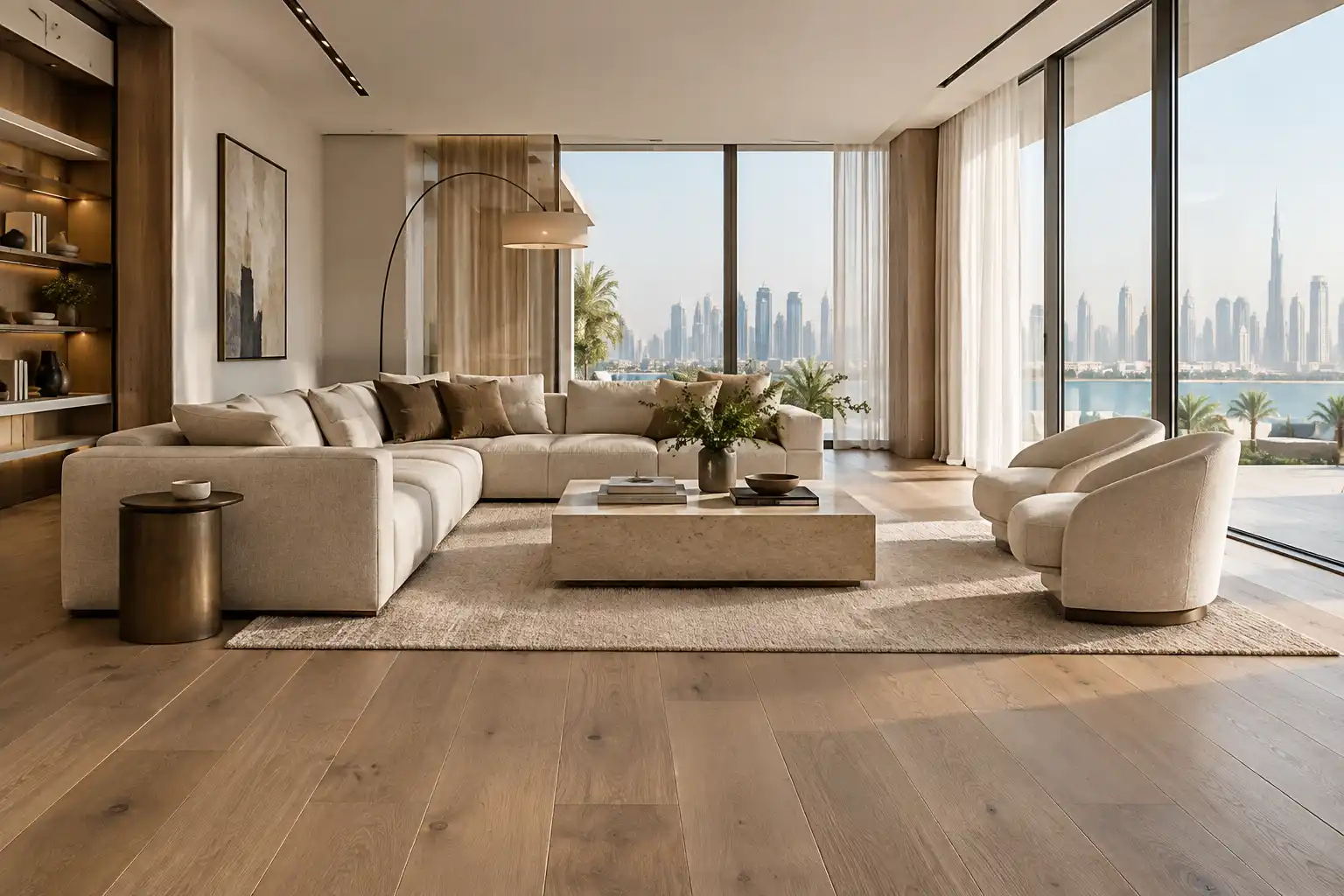
Yes, for most interior living spaces. It copes with AC-controlled conditions better than solid wood, as long as the subfloor is dry and the humidity stays reasonably steady.
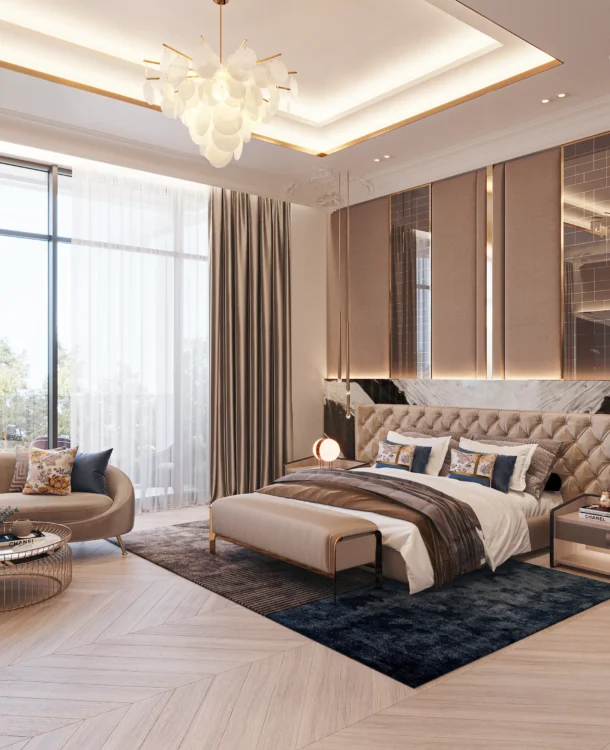
Three benefits stand out. It’s more dimensionally stable, so gaps and cupping are less likely. It can go over concrete slabs, which is what most UAE villas and apartments have. And it comes in wide planks, herringbone and chevron patterns that solid wood struggles to hold flat.
Still, it’s a better-behaved material, not a maintenance-free one. A bad installation will beat a good board every time.
How Does the UAE Climate Affect a Wood Floor?
Mostly through indoor humidity swings, sunlight through glass and dust, not through outdoor heat itself. Your AC controls what the floor actually feels, so how you run it matters. For wider context, see how the UAE climate shapes interior design choices.
What happens to wood floors when a home is empty in summer?
Humidity can rise and fall sharply, and the boards may absorb then release moisture, which can open gaps or lift edges over repeated cycles.
One detail that often gets overlooked is the summer trip. Owners leave in July or August, switch the AC off or set it very high, and come back to humid air. When cooling restarts, the boards dry again. Do that for a few summers and gaps can appear.
The fix is simple: keep the AC on a steady, moderate setting while you’re away. Many manufacturers also publish an ideal indoor humidity range, so check the data sheet for your exact board.
Does sunlight damage engineered wood?
It can fade or darken the surface over time, especially next to large glazing. The effect is uneven, so you’ll see lighter patches where rugs or furniture sat.
If your living room has floor-to-ceiling glass, plan for it. Choose a UV-resistant finish where the manufacturer offers one, and use curtains or glass treatments in the worst-hit rooms.
How do dust and sand affect it?
Fine dust acts like sandpaper underfoot and dulls the finish faster. Good entrance mats and soft-head vacuuming slow that down.
Near balconies, terraces and pool access, wet feet and spills are the bigger risk. Engineered wood handles moisture better than solid wood, but it isn’t waterproof.
Which Finish Should You Choose?
Pick matt or UV lacquer for low upkeep and busy homes, and hardwax oil for a natural feel that’s easy to spot repair. Behaviour varies by product, so confirm with the manufacturer.
| Finish | Look | Upkeep | Repairs | Best for |
|---|---|---|---|---|
| Matt or UV lacquer | Clean, even, modern | Low, wipe clean | Harder to patch locally | Busy family homes |
| Hardwax oil | Soft, natural, low sheen | Occasional re-oiling | Easy to spot repair | Living rooms and bedrooms |
| Brushed or textured | Visible grain, hides marks | Low to medium | Depends on top finish | Kids and pets |
| Smoked or white-washed | Distinct colour effect | Depends on top finish | Colour matching can be tricky | Design-led interiors |
Lighter floors show dust quickly. Darker floors show scratches. So choose for how you actually live, not for how a sample looks under showroom lights.
If you need something tougher around water, compare it with SPC flooring, which behaves very differently under wear and moisture.
What Should You Check on the Spec Sheet?
The wear layer thickness and the core type. Those two tell you more about lifespan than the brand name.
Wear layer. This is the real wood on top, and it ranges from a thin veneer to several millimetres depending on the product. A thicker layer can usually be sanded and refinished. A very thin one may not allow it. Ask how many refinishes the board supports.
Core. Plywood and HDF cores react differently to moisture and fixing methods. Ask for the core type and the moisture performance of that specific board, not a general sales line.
Plank width matters too. Very wide planks look dramatic, but they move more and need a flatter, drier base.
Why Does the Subfloor Matter So Much?
Because floors fail from the bottom up. An uneven or damp slab can cause creaking, gaps and lifting, even with a premium board on top.
This is the stage worth slowing down for, especially in new builds, handovers and bigger home renovation jobs.
Check three things before laying. First is flatness, because an uneven slab makes planks flex and creak. Second is screed moisture, since new screed can hold water and should be tested against the manufacturer’s limit. Third is the installation method: floating, glue-down or a mix. Glue-down generally feels more solid, while floating is faster and easier to replace, though the right choice depends on the product and the room.
Follow the manufacturer’s installation instructions closely, as they often affect warranty cover. I can’t verify any specific warranty terms here.
Where Can You Use It, and Where Should You Avoid It?
Use it in living rooms, bedrooms, hallways and many open-plan spaces. Avoid bathrooms, outdoor areas and anywhere water sits regularly.
Be careful in kitchens, near AC condensate lines and on ground-floor villa areas where ground moisture could be an issue. For wet zones, tiles or another suitable surface are safer.
A hypothetical example. Imagine a villa with a double-height living room and floor-to-ceiling glazing, and the owner wants very wide oak planks. A smarter plan might be a medium-width plank with a UV-resistant finish, a moisture-tested slab and a rug layout that avoids hard sun lines. It still looks luxurious, with less that can go wrong. See how villa interiors are planned as a whole.
Apartments raise their own questions: sound travelling to neighbours below, building rules on flooring and shared water risks. Check with building management before ordering. Our guide to apartment interiors in Dubai covers the wider planning.
For shops and offices, traffic and cleaning schedules matter more than in homes. A fit-out team should confirm suitability for the expected load.
What Affects the Cost of Engineered Wood Flooring?
Species, wear layer thickness, plank width, finish, laying pattern and subfloor preparation. I’m not quoting per-square-metre prices because quotes vary widely and current figures aren’t verified.
- Wood species and grade
- Wear layer thickness and plank width
- Finish type
- Pattern (herringbone and chevron cost more to lay than straight planks)
- Subfloor levelling and moisture work
- Installation method and underlay
- Skirting and transitions
People often overspend on exotic species when a thicker oak wear layer would serve them better. They also underspend on subfloor prep, which tends to cost more later. Small details like skirting and thresholds deserve the same care as custom joinery. For the bigger picture, read our guide to interior design costs in the UAE.
What Mistakes Do People Make?
Buying by photo, ignoring the subfloor, treating the floor as waterproof and switching off the AC all summer.
Buying by photo. A sample in daylight can look quite different under your lighting and glazing. Test a full plank in the actual room.
Ignoring the subfloor. Schedule pressure is usually the cause. Gaps, lifting or squeaking is the result. A tested, levelled slab prevents most of it.
Treating it as waterproof. Standing water can damage edges and the core. Wipe spills fast and fix leaks promptly.
Switching off the AC. Large humidity swings are hard on wood, as covered above.
Frequently Asked Questions
Q1: Does engineered wood flooring warp in Dubai?
A: It can, but it’s less likely than with solid wood. Warping usually comes from a damp subfloor, poor installation or big humidity swings, not from the board type alone.
Q2: Can engineered wood flooring be refinished?
A: Sometimes. It depends on the wear layer thickness. A thick layer may be sanded and refinished, while a thin one may not. Ask for the product data sheet.
Q3: Can I use engineered wood in a kitchen or bathroom?
A: Kitchens can work with careful spill control and good edge sealing. Bathrooms aren’t recommended, because engineered wood isn’t designed for repeated wetting.
Q4: How long does engineered wood flooring last?
A: It varies with wear layer, finish, subfloor, maintenance and sun exposure. I can’t give a verified lifespan, so ask the manufacturer for guidance on the specific product.
Ready to Plan Your Floor?
A wood floor is a design decision as much as a material one. It affects light, furniture, joinery and how a room feels every day. If you want help choosing a finish, checking a subfloor or fitting flooring into a wider plan, talk to the team at La Firma about your space.