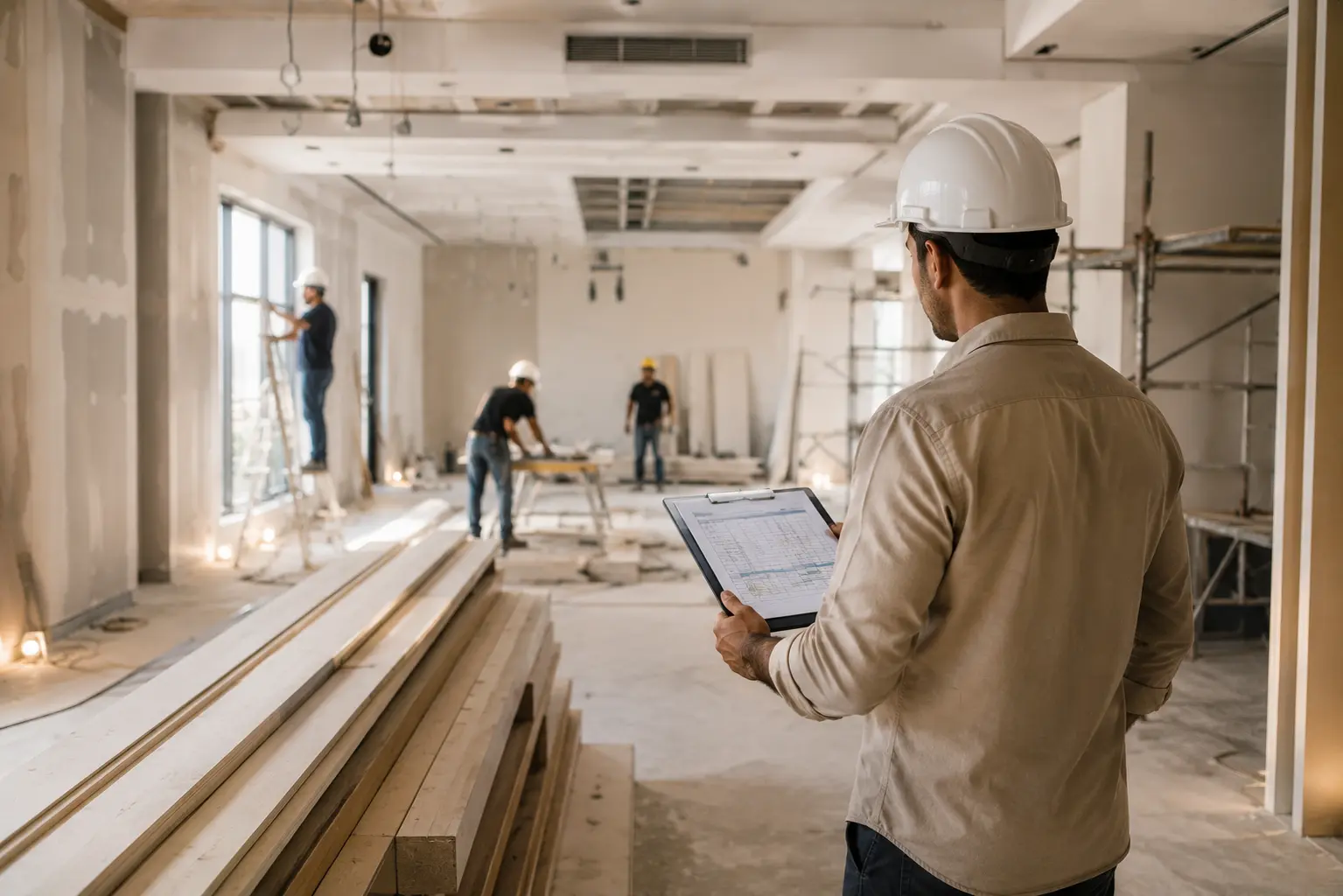
Interior project management is the role that oversees a design or fit-out project from start to finish managing budget, timeline, vendor coordination, quality control and communication between everyone involved. It typically includes scheduling, procurement tracking, site supervision, risk management and handover coordination. It’s the function that keeps a project on track, not the design or construction work itself.
Key takeaway:
Interior project management isn’t design, and it isn’t construction. It’s the coordination layer that keeps design, procurement and fit-out moving together, on budget and on schedule.
Interior project management is the role that keeps a design or fit-out project moving, on budget and on schedule. It sits above the day-to-day design and construction work, coordinating everyone involved rather than doing the design or building itself.
Most people run into this term once a project involves more than one contractor. That’s when someone needs to own the schedule, the budget and the handoffs between trades.
Understanding what a project team actually does day to day helps you see where that role fits into a project. It also clarifies what you’re paying for.
This breaks down what interior project management includes, how it differs from design and execution, and what it typically costs.
What Does “Interior Project Management” Actually Mean?
Interior project management means overseeing every moving part of a design or fit-out project. It exists so nothing falls through the gaps between trades. One person or team tracks budget, schedule, quality and communication across the whole project.
Without it, the designer, the contractor, the joinery workshop and the client are all coordinating separately, often with different information. That’s usually where delays and cost overruns start.
Project Management vs Design vs Execution vs Supervision
These four roles overlap in people’s minds, but they cover different parts of a project.
Interior design decides what a space should look like and how it should function, before anything gets built. Interior project management makes sure that plan actually happens, on time and on budget.
Project execution is the hands-on work of building it: the trades on site, the joinery installation, the finishing. Project management coordinates when each of those things happens and who’s responsible.
| Role | What It Covers |
|---|---|
| Interior Design | Deciding the look, layout and function of a space |
| Project Management | Coordinating budget, schedule, vendors and quality across the whole project |
| Execution | The hands-on construction, installation and fit-out work on site |
| Supervision | Checking day-to-day site quality against the approved design |
What Interior Project Management Actually Includes
A typical project management scope covers five connected areas, whether it’s a villa, an office or a retail unit.
Budget Management and Cost Tracking
This covers setting the budget, tracking spend against it, and flagging cost overruns before they get out of hand. Understanding what typically drives interior design costs in the UAE makes this tracking far more accurate from the start.
Timeline and Scheduling
This covers building a realistic schedule and adjusting it as procurement or site issues come up. A realistic project timeline for interior work in Dubai accounts for lead times most people underestimate.
Vendor and Contractor Coordination
This covers scheduling trades so they don’t clash on site, and chasing suppliers on delivery dates. It also means making sure everyone works from the current version of the design. It’s often the least visible part of the job, and the most time-consuming.
Quality Control and Site Supervision
This covers checking work against approved drawings, catching issues before they get built over, and running the final snagging walkthrough. A construction supervision checklist for UAE projects shows what this level of detail actually looks like.
Handover and Risk Management
This covers spotting problems before they become expensive, from a delayed shipment to a design clash discovered on site. It also covers the final handover — confirming the finished space matches what everyone agreed at the start.
Residential vs Commercial Project Management in the UAE
Residential project management on a villa usually means coordinating around family life, keeping some rooms usable during construction.
Commercial project management, especially for an office fit-out, usually runs against a hard deadline instead. An office renovation checklist for UAE businesses shows how tightly teams manage commercial timelines around a fixed move-in date.
A UAE Scenario: Managing a Multi-Trade Villa Renovation
Picture a villa renovation involving a joinery workshop, an MEP contractor, a flooring supplier and a furniture team. Without one person tracking the sequence, the flooring team showed up before electricians finished the rough-in. The whole schedule slipped by two weeks.
Once a project manager took over the sequencing, each trade got a confirmed start date instead of guessing. The project finished close to the original timeline, with far fewer surprises along the way.
Common Project Management Mistakes to Avoid
A few mistakes come up repeatedly on multi-trade UAE projects:
- Starting a multi-trade project without a single point of coordination
- Tracking budget only at the end of a project, not throughout it
- Assuming the contractor will manage vendor scheduling automatically
- Skipping regular site checks between major milestones
- Treating handover as a single day instead of a checklist
Knowing what starting a fit-out project in the UAE actually involves helps set up the right coordination from day one.
How Project Management Affects Cost and Timeline
Project management typically adds a fee on top of design and construction costs. It usually saves more than it costs, through fewer delays and less rework.
A well-run schedule keeps trades from waiting on each other. That waiting is one of the biggest hidden costs on a multi-trade project.
Q1: What does interior project management actually include?
A: It covers budget management, scheduling, vendor and contractor coordination, quality control and handover coordination. It’s the oversight layer that keeps design, procurement and fit-out moving together, rather than the design or construction work itself.
Q2: How is project management different from interior design?
A: Interior design decides what a space should look like and how it should function. Project management makes sure that plan actually gets built, on time and on budget.
Q3: Do I need project management for a small renovation?
A: For a single-trade job, probably not. Once a project involves multiple contractors, suppliers or a fixed deadline, coordination gets harder to manage alone. That’s when project management starts paying for itself.
Q4: Who handles project management on a UAE fit-out project?
A: It depends on how the project is structured. Some companies include it as part of a full-service package. Others offer it as a standalone service alongside separate design and fit-out contracts.
Q5: How much does interior project management cost in the UAE?
A: It varies by project size and complexity. Most companies build it into a full-service fee rather than charging it as a flat separate rate. It typically pays for itself through fewer delays and less rework.
CONCLUSION
Ready to Put Someone in Charge of the Whole Project?
Good interior project management is easy to miss when it’s working, and impossible to miss when it isn’t. It’s the difference between a project that runs smoothly and one that turns into a series of small fires.
Every fit-out project at La Firma comes with dedicated project management, covering budget, schedule and coordination through to handover.