Written from direct industry experience working with kitchen cabinetry and joinery across Dubai and UAE villas.
Introduction
Choosing a cabinet material rarely feels like a high-stakes decision at the design stage. Every sample looks fine under showroom lighting, and the difference between options often comes down to a few dirhams per linear meter. The real test happens eighteen months later, when one kitchen still closes smoothly and another has swollen doors, peeling laminate, or hinges pulling away from softened board. Material choice, more than almost any other kitchen decision, is where UAE’s heat and humidity quietly decide the winner over time.
The underlying logic here is consistent across regions and applications, similar to how Sharjah furniture workshops rely on properly sealed timber cores to prevent warping in outdoor-facing pieces, except a kitchen faces that same moisture challenge every single day rather than occasionally. Getting this right at the Home Interior Design stage, before cabinetry is ordered, is far cheaper than replacing swollen doors two summers later, and it’s a detail La Firma Interiors’ villa and house designs account for early in any home renovation Dubai project.
Key takeaways:
- Moisture resistant board and proper sealing matter more in the UAE than the material name on the sample itself.
- Marine grade plywood and moisture resistant MDF are the two materials most commonly specified for Dubai kitchens.
- The most common mistake is choosing a finish based on appearance before confirming the core material underneath it, a detail that belongs in the Home Interior Design brief and Project Management schedule from day one.
- This guide is written for villa owners and homeowners planning a kitchen renovation or new build, not for buyers of flat-pack furniture.
Why Does Cabinet Material Matter So Much in the UAE Climate?
Cabinet material matters this much in the UAE because sustained indoor humidity, heat from daily cooking, and air conditioning cycling on and off all stress the board and finish far more than they would in a drier or more temperate climate, and a material that isn’t rated for that stress tends to fail within a few years rather than lasting a decade or more.
Standard vs Moisture Resistant Cabinet Materials
| Factor | Standard MDF or Chipboard | Moisture Resistant MDF or Marine Plywood |
|---|---|---|
| Swelling risk near sink or wet kitchen | High | Low |
| Typical lifespan in a UAE kitchen | 3 to 6 years | 12 to 20 years |
| Upfront cost | Lower | Moderate to higher |
| Recommended for | Dry storage away from water | Any cabinet near water or humidity |
Does This Mean You Should Avoid Standard MDF Entirely?
Not necessarily. Standard board still works reasonably well in upper cabinets or dry storage areas away from the sink and wet kitchen, while moisture resistant board is worth the extra cost specifically where water exposure and humidity are highest, closer to the sink, dishwasher, and any cabinetry inside a wet kitchen.
Key Terms UAE Homeowners Should Understand
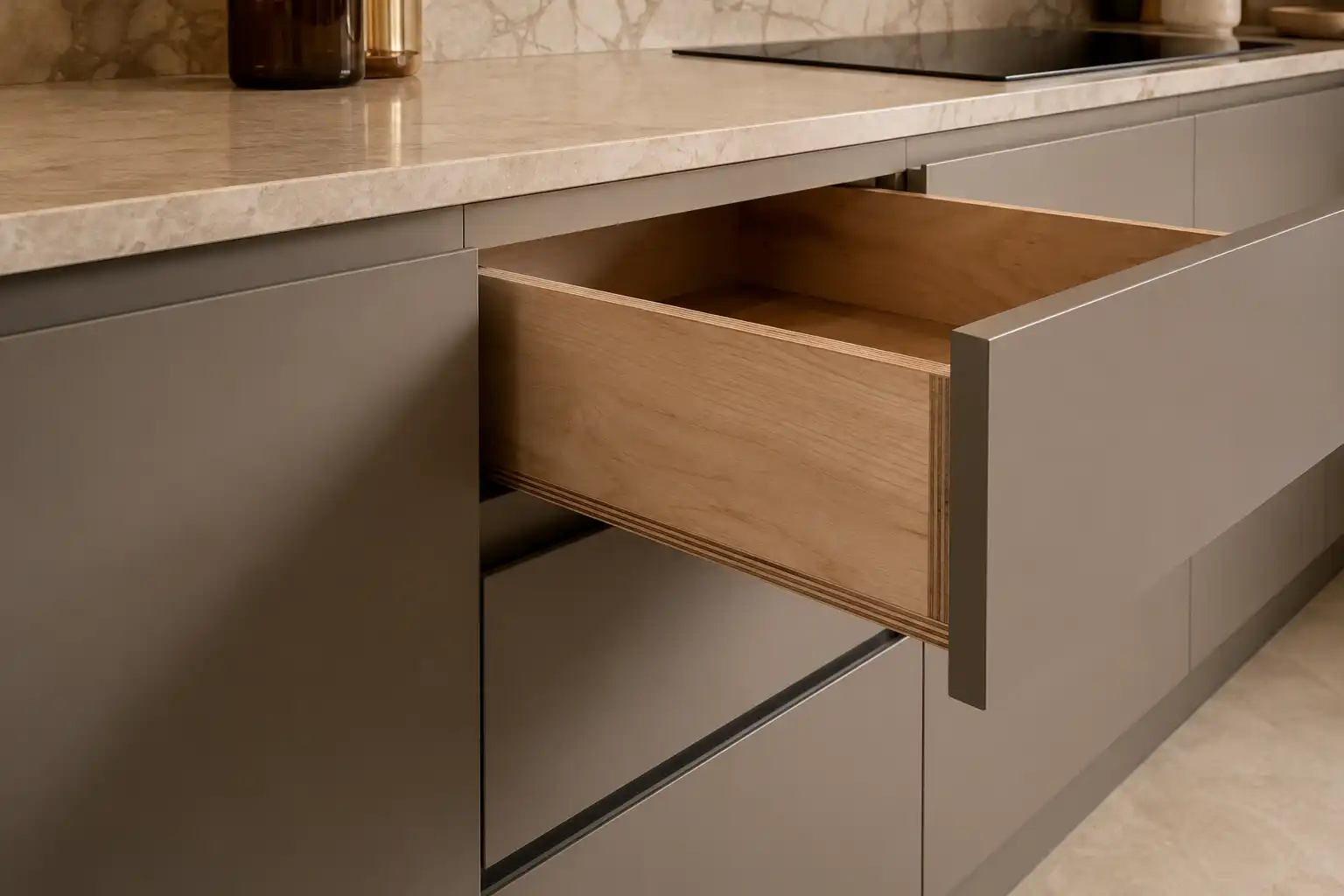
Marine grade plywood: layered timber bonded with waterproof adhesive, resistant to swelling even with regular moisture exposure.
Moisture resistant MDF: engineered board treated to resist water absorption, a common mid-range choice for Dubai kitchen cabinetry.
PET or acrylic lacquer finish: a sealed, high gloss or matte surface applied over board, chosen for its resistance to humidity and easy cleaning.
Edge banding: the sealed strip along a panel’s exposed edge, often the first place swelling begins if it isn’t properly applied.
What Cabinet Materials Do UAE Kitchens Commonly Use?
Marine Grade Plywood for Wet Kitchen Cabinetry
Marine grade plywood is the material most often specified for wet kitchen cabinetry, since it handles constant humidity and occasional direct water contact better than any board-based alternative, making it worth the higher cost in the areas that see the most daily moisture.
Moisture Resistant MDF for the Main Show Kitchen
Moisture resistant MDF suits the main show kitchen well, offering a smoother surface for lacquer or veneer finishes at a lower cost than plywood, while still holding up reasonably against the humidity of a household that cooks daily rather than occasionally.
PET and Acrylic Lacquer Finishes Over Solid Cores
PET and acrylic lacquer finishes have become popular over the past few years because they resist fingerprints and humidity marks better than traditional high gloss polyurethane, while giving a similar sleek appearance that suits modern furniture design trends in Dubai villas.
Solid Timber for Statement Pieces
Solid timber, properly kiln dried and sealed, still has a place in UAE kitchens, usually reserved for an island face, open shelving, or a statement element rather than the full cabinet run, since full timber runs are more sensitive to humidity swings than engineered alternatives.
Matching Material to Kitchen Zone
| Kitchen Zone | Recommended Material | Why It Fits |
|---|---|---|
| Under sink cabinetry | Marine grade plywood | Handles direct water exposure |
| Wet kitchen cabinetry | Marine grade plywood | Constant humidity resistance |
| Main show kitchen cabinetry | Moisture resistant MDF | Smooth finish, moderate cost |
| Island feature panels | Solid timber or veneer | Visual statement piece |
| Upper dry storage | Standard MDF acceptable | Lower moisture exposure |
Example: How a Dubai Villa Avoided a Common Cabinet Mistake
A villa renovation in Arabian Ranches originally specified standard board throughout the kitchen to save on the initial quote, including the cabinets flanking the sink and dishwasher. During the Fit-Outs planning stage, the material spec was revised so that only the sink-adjacent and wet kitchen cabinetry used marine grade plywood, while the rest of the kitchen kept standard moisture resistant MDF. Two years on, the swap held up exactly where it mattered, with no swelling near the water-exposed sections, while the small cost increase was limited to the cabinets that actually needed it rather than the whole kitchen.
What Mistakes Do UAE Homeowners Commonly Make?
Choosing a Finish Before Confirming the Core Material
Homeowners often pick a lacquer color or laminate pattern from a sample board without asking what’s underneath it. Two cabinets can look identical in a showroom while one uses standard board and the other uses moisture resistant board, with a very different lifespan once installed.
Skipping Proper Edge Sealing
Swelling almost always starts at an exposed or poorly sealed edge before it spreads across a panel. Confirming that edge banding is properly applied, especially on cabinets near the sink, prevents the most common early failure point.
Using the Same Material Throughout the Whole Kitchen
Specifying marine grade plywood everywhere adds unnecessary cost, while using standard board everywhere risks early failure near water sources. Matching material to zone, as outlined above, is usually the more sensible approach for both budget and Project Management.
Three Rules for Choosing Cabinet Material in the UAE
- Match the material to the zone, using moisture resistant board or marine plywood near water and standard board only in dry storage.
- Confirm edge banding quality, since that’s where swelling typically begins.
- Choose the finish after confirming the core material, not before.
Are There Other Materials Worth Considering as Budgets Allow?
Yes, homeowners with more flexible budgets sometimes explore high pressure laminate for extra durability in high traffic households, or genuine timber veneer over an engineered core for a warmer look without the humidity sensitivity of solid timber throughout.
High pressure laminate resists scratches and heat better than standard lacquer, making it a reasonable option for larger families or households where the kitchen sees heavy daily use. Timber veneer over a stable engineered core gives much of the warmth of solid wood while behaving more predictably in a humid environment.
How Should You Choose a Cabinet Material for Your Kitchen?
A reliable approach when briefing an interior fit-out company in Dubai, whether for a villa or for Office Interior Design Dubai UAE projects that share the same humidity concerns, looks something like this:
- Identify which cabinets sit near water or high humidity and prioritize moisture resistant materials there first.
- Ask what core material sits beneath any finish sample before approving it.
- Confirm edge banding and sealing standards as part of the Fit-Outs specification, not as an afterthought.
- Reserve solid timber for accents rather than full cabinet runs unless budget and maintenance expectations allow for it.
Frequently Asked Questions
Is MDF a bad choice for kitchen cabinets in Dubai?
Not entirely. Standard MDF works fine in dry storage areas away from water, while moisture resistant MDF or marine plywood is the better choice anywhere near a sink or wet kitchen.
How long do UAE kitchen cabinets typically last?
With the right material and proper sealing, well-specified cabinetry can last 12 to 20 years. Cabinets using standard board near water sources often show problems within 3 to 6 years.
Is marine grade plywood worth the extra cost for a whole kitchen?
Not always. It’s generally worth prioritizing for wet kitchen and under-sink cabinetry specifically, rather than the entire kitchen, to balance durability with budget.
Can swollen cabinet doors be repaired, or do they need replacing?
Minor swelling can sometimes be sanded and resealed, but significant swelling usually means the board has already absorbed moisture internally, at which point replacement is the more reliable fix.
Does villa interior design Dubai pricing typically include material upgrades like marine plywood?
It depends on the quote. Always confirm which cabinets use which material in a quote, since a lower total price sometimes reflects standard board used throughout rather than a genuine cost saving.
Conclusion
Cabinet material is one of those decisions that looks minor at the design stage and becomes very visible two or three summers later. UAE homeowners who match material to zone, confirm what sits beneath the finish, and check edge sealing standards tend to avoid the swelling and early wear that catches so many renovations off guard, which is exactly the kind of detail that separates the best interior design company in Dubai from a purely budget-driven contractor. A modern office interior designer in Dubai faces the same material decisions on commercial pantries and breakout kitchens, so the same rules apply well beyond the home. If you’re working through this decision as part of a broader Home Interior Design plan, involving an experienced Project Management team and Fit-Outs specialist early, alongside a clear brief on furniture design and finishes, makes it far easier to specify the right material in the right place from the start.